
Conscious Discipline creates change via an adult-first practice, meaning it approaches the adult’s learning first. Implementation requires adults to reflect and internalize new concepts and practices. This empowers them to see behavior differently, teach the desired skills, model these skills in daily interactions, provide responsive care, and create interventions that are individuated and effective.
A dysregulated adult cannot help children regulate, so personal self-regulation is the cornerstone of any Conscious Discipline practice.
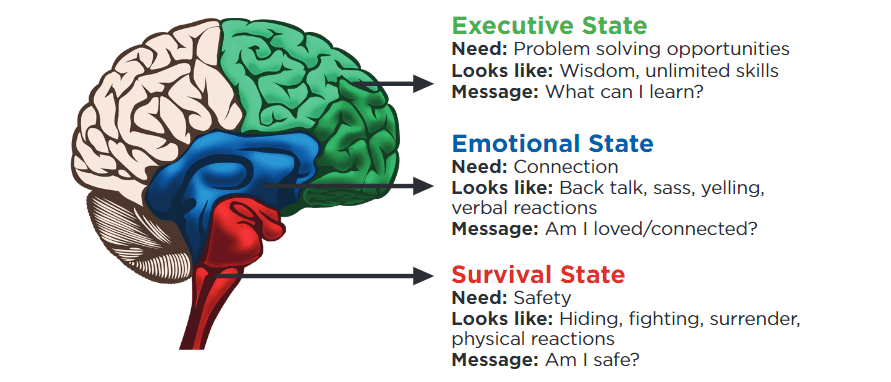
Building on that, Conscious Discipline creates a compassionate culture between adults and children by shifting adult perceptions and understanding of child behavior. The Conscious Discipline Brain State Model is a useful way of explaining behavior. Although the human brain is infinitely complex and integrated, this simplified model helps us understand the needs underlying children’s behaviors. This knowledge helps us to move from judging and punishing to acceptance and teaching.
The Survival State (Am I safe?), Emotional State (Am I loved?), and Executive State (What can I learn?) are the three brain-body states represented in the model.